
(9 min. read)

Topical Authority in Light of the Google Leak
siteFocusScore) emerged as a critical quality parameter. It is a mathematical metric that draws a hard line between expert-led services and generalist sites. The documentation also introduces Site Radius (siteRadius), which complements Site Focus by describing the degree of topical dispersion of content within a domain.
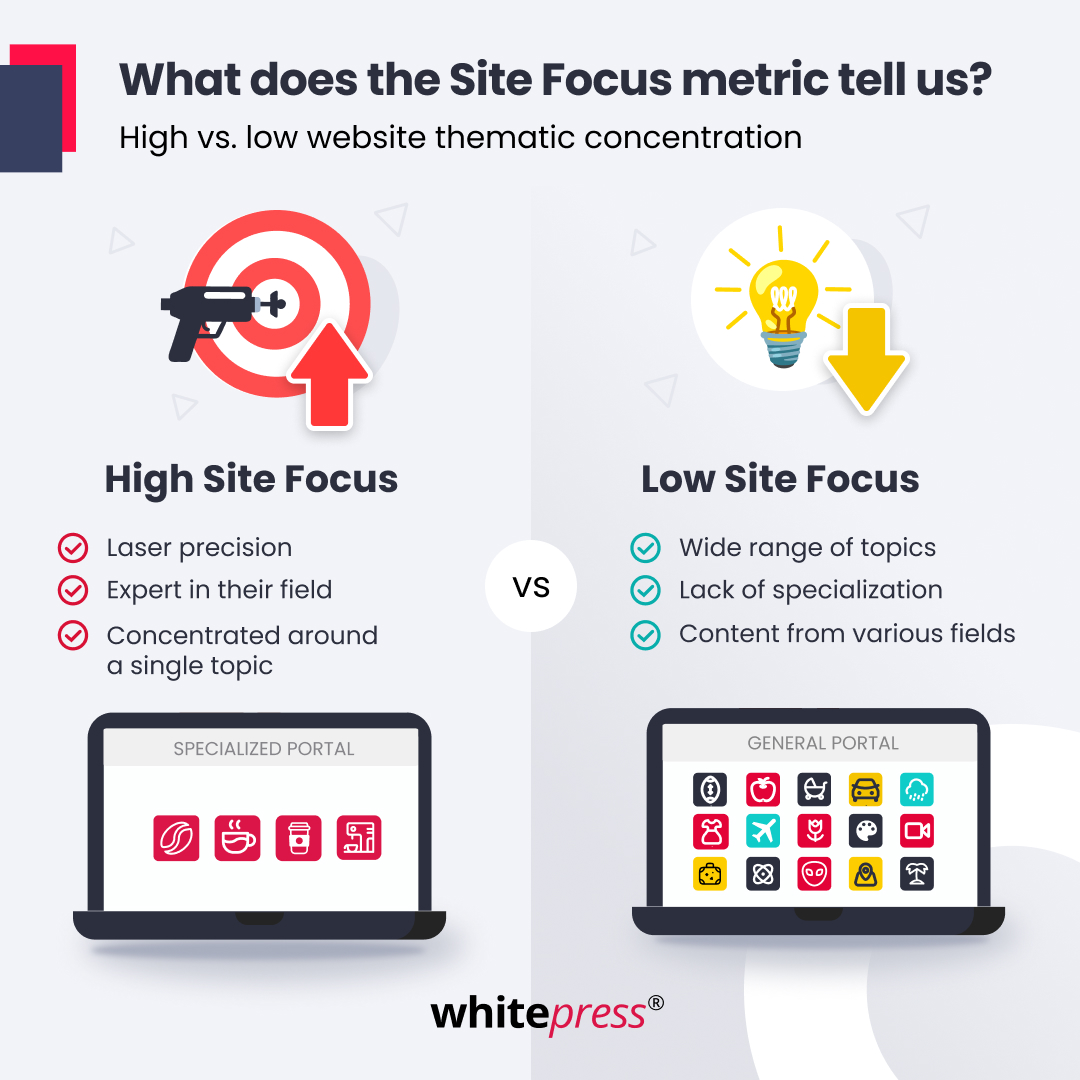
What is Site Focus?
siteFocusScore parameter is a numerical value that defines a domain’s level of thematic concentration. Put simply, it’s a metric that answers one core question: Is this website a specialized expert in a single field, or just another generalist portal?- High Site Focus (The Laser Effect): Imagine a site that publishes content exclusively on one topic—for example, specialty coffee brewing. Every article is thematically interconnected. The "energy" of this site acts like a laser—narrow, but incredibly powerful and precise. For algorithms, such a site is the undisputed authority in its niche.
-
Low Site Focus (The Lightbulb Effect): On the other end of the spectrum are multi-topic portals covering everything from construction to high fashion. Their content is scattered across the entire thematic map. They function like a standard lightbulb—they illuminate a wide area, but the light is diffused and weak. Such a site has a low focus score because it lacks a clear specialization.
Comment

Matuesz Godzic, Head of Growth at WhitePress®
Today, SEO is becoming an engineering of precision, and the rise of AI is only accelerating that pace. There’s no longer room for guesswork or basing strategies on hollow metrics. You need to know exactly why you’re choosing a specific portal for publication. The key is crafting content that builds authority—not just in Google, but across all channels that draw knowledge from our work. The era of manipulation and 'forcing' traffic through unrelated keywords is slowly fading. This revolution won't happen overnight, but its progress is steady and inevitable.
How is the Site Focus score calculated?
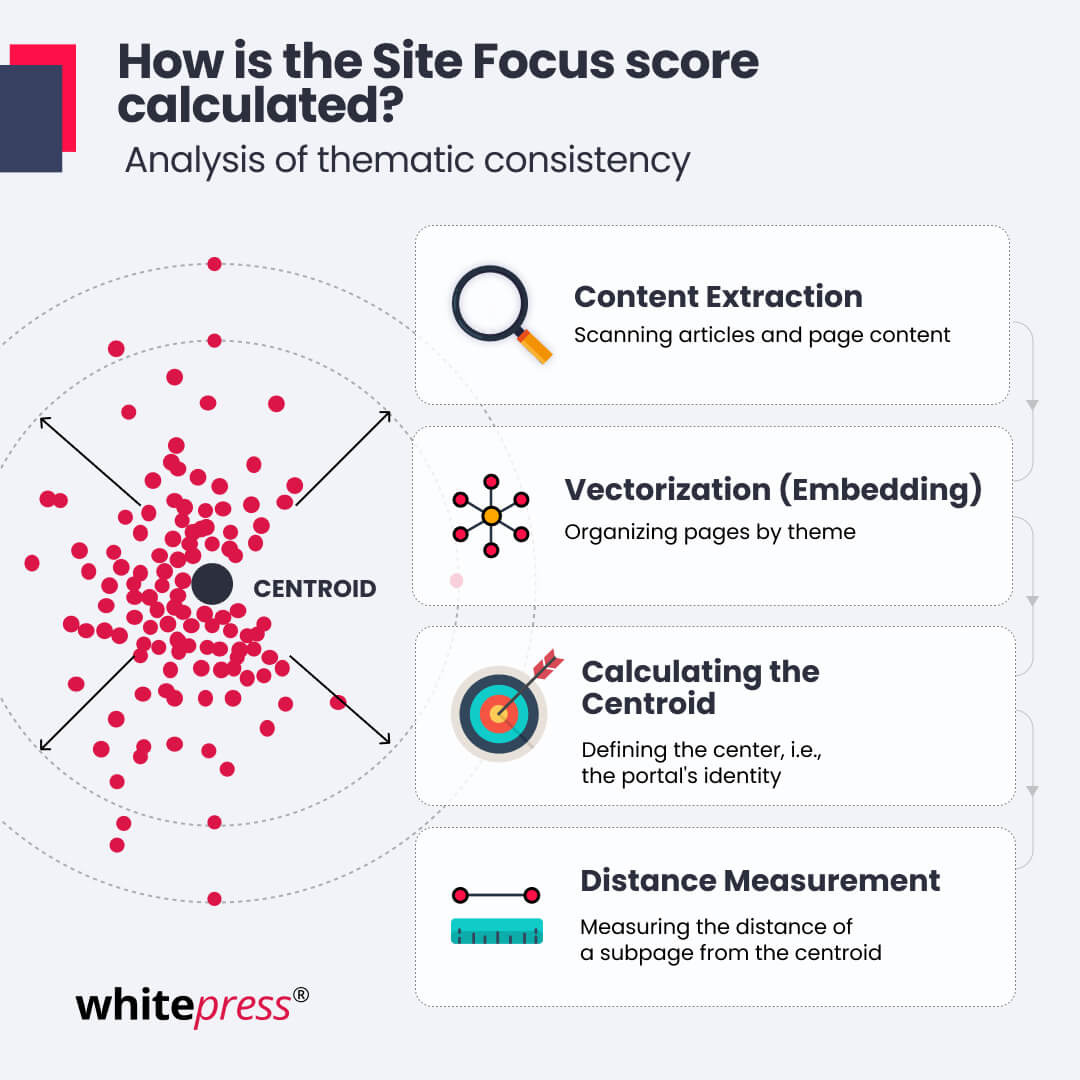
- Content Extraction: The process begins by crawling the sitemap and extracting key textual data from every subpage. The goal is to isolate the "semantic DNA" of each article.
- Vectorization (Embedding): Next, word-based representations are converted into mathematical representations called vectors, which are then embedded in a multi-dimensional space. In this environment, "meaning" equals "location"—texts with similar themes land close to one another.
- Calculating the Centroid (The Heart of the Site): This is the most critical step. An average vector, known as the centroid, is calculated for all the vectors (pages) on a given domain. The centroid is the site’s mathematical "center of gravity." It defines the portal’s identity—the point around which all content orbits.
- Distance Measurement: Finally, the system measures how closely individual pages sit to this centroid. The more densely the vectors are clustered around the center, the higher the Site Focus score.
Why raw numbers aren't enough
The Solution: Calibration
What is Site Radius?
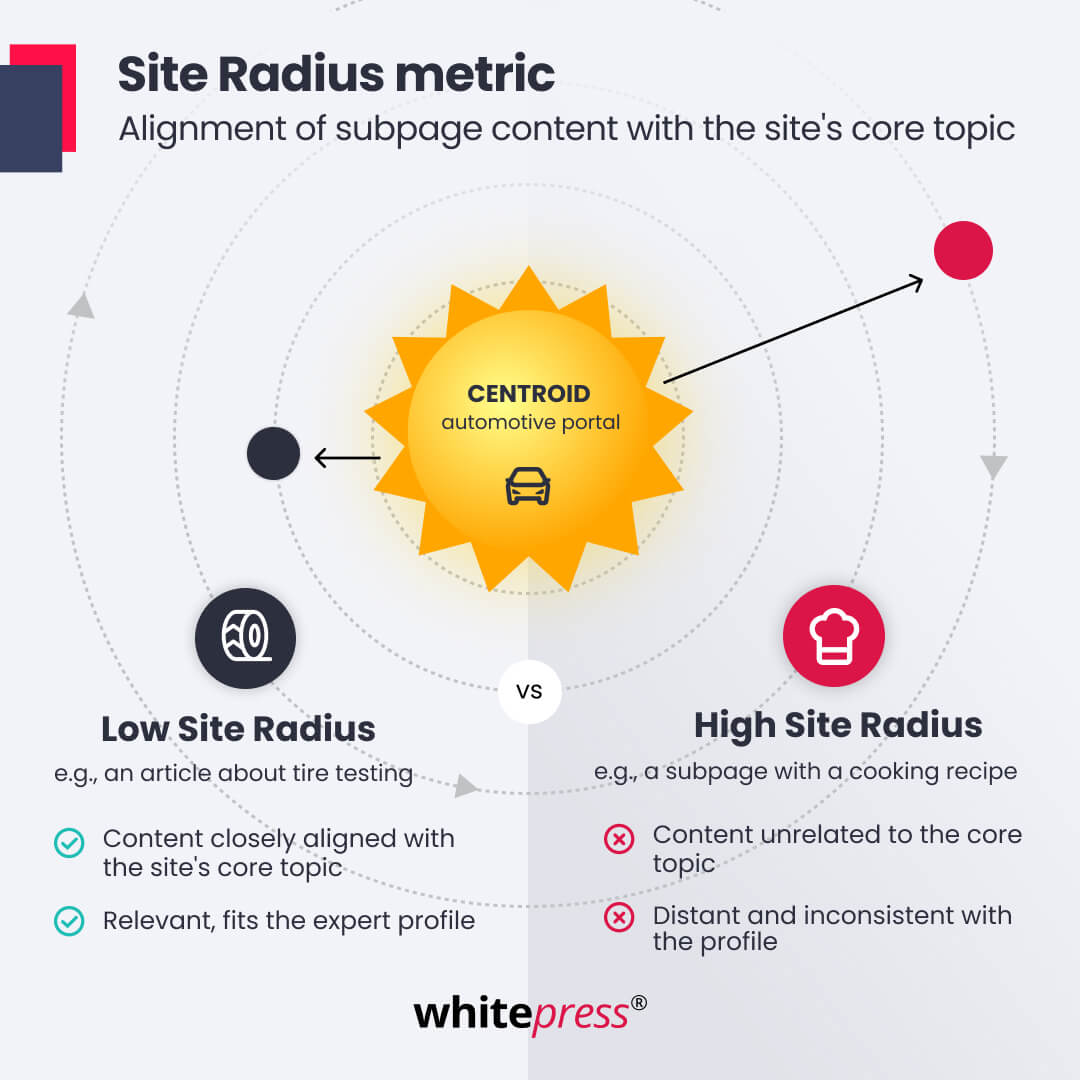
- The Sun (Centroid): The primary subject of the website (e.g., "Automotive").
- The Planets (Subpages): Individual articles.
- The Orbit (Radius): The distance of a planet from the Sun.
-
Low Site Radius (A Tight Orbit): An article closely aligned with the core topic (e.g., a piece about tires on an automotive portal) stays close to “the Sun.” This signals that the content is relevant and fits the site’s expert profile.
- High Site Radius (The Comet): If that same portal publishes an article completely unrelated to cars (e.g., a cooking recipe), it will end up in a very distant orbit. Its vector sits far away from the centroid.
How to use these metrics in practice?
Precision in choosing publication placements
Comment

Katarina Dahlin, Senior Growth Hacker &
A few years ago, I could rank a single site for multiple unrelated topics without much difficulty. Today, this no longer works, whereas the topically focused sites are outranking broader ones, even when the broader sites have more content. The way the algorithm ranks sites has noticeably changed, making content pruning and a more critical approach to content creation essential. The same principle applies to link building. Choosing topically relevant publishers has become critical for link building success.
Topical Hygiene and Content Pruning
For website owners, these metrics are extremely valuable and become a powerful diagnostic tool. They allow you to precisely identify subpages that stray too far from the core topic. This makes it easier to find articles that weaken a domain’s authority — for example, outdated content that no longer fits the site’s current profile.
Often, removing content (so-called content pruning) can increase a domain’s authority more effectively than publishing new articles. In some cases, simply updating the text, merging it with other content, or placing it in a stronger thematic context is enough.
Automatic Categorization
Comment

Itamar Blauer, Head of Marketing &
Site Focus and Site Radius provide a clearer picture of a website’s relevance based on mathematical calculations that are contextual to a site’s actual content. It allows marketers to quickly see whether a site is deeply specialised, broadly themed, or scattered across topics, and how closely it matches the subjects they want to be associated with.
Mathematics: The New Currency of SEO

Head of Growth, WhitePress®

SEO & Digital Marketing Specialist