(14 min. read)
This article was written by Katarina Dahlin, Senior Growth Hacker at WhitePress®.
I have been spending my time on the off-page side of LLM optimization, tracking WhitePress® AI visibility, studying competitors, and testing different approaches to brand mention placement. Sure, the content on your own website is very significant too. How you structure it, how clearly you answer questions, and how often you update it all affect whether AI can extract and cite your content. But this article focuses on the off-page side.
Let's start with how AI actually finds and picks information. Then we'll go through how to get your brand into those answers.
TL;DR
- AI answers mention ~3 brands per query. If yours isn't one of them, a competitor is. In a zero-click environment, that's where decisions are made.
- YouTube mentions, branded web mentions, and branded anchors correlate more strongly with AI visibility than traditional SEO metrics like backlinks or Domain Rating.
- Consistency is everything. AI pieces together your brand from your website, social profiles, reviews, and third-party content. Conflicting messages confuse it, while consistent ones get repeated.
- Place specific, positioned brand descriptions on sources AI already trusts: pages ranking for your keywords, domains cited in AI Overviews, niche authority sites, Reddit, YouTube, and review platforms.
- Don't just chase mentions, instead control what's being said. Generic descriptions give AI nothing to work with. Specific positioning, numbers, and use cases are what get extracted and recommended.
- Start now. AI systems are still forming source preferences. Early brand visibility compounds. The work also strengthens your E-E-A-T signals in Google Search.
How search has changed
With AI Mode, AI Overviews and LLMs, we are living in a zero-click environment now. A Growth Memo usability study found that AI Mode sessions had a 100% zero-click rate except for transactions (Indig &
We get more impressions with the AI Overviews, but clicks are going down. An Ahrefs study of 300,000 keywords found that AI Overviews alone reduce clicks to the number one result by 58% (Law, 2026). And AI Overviews are just one part of the picture. Users increasingly get their answers directly from AI Mode, ChatGPT, Perplexity, and other AI tools without ever clicking out to a website.
The research happens inside the AI environment, without clicking out to websites. For ecommerce, AI Mode and ChatGPT are already moving toward instant checkout, where users can browse and buy without ever leaving the conversation. And across industries, users increasingly ask AI to compare options, shortlist brands, or recommend providers, all without visiting a single website.
But there is an upside. A Senuto analysis found that 61% of organic traffic lost to AI Overviews can potentially be recovered by becoming a cited source in the AI answer (Sałkowski &
Your brand needs to be mentioned where your competitors are being mentioned. It's no longer just about rankings and traffic. It's about being visible in the AI environments where your potential customers are making decisions. The brands that win are the ones that LLMs choose to cite because their mentions are consistent, specific, and well-sourced, and that users see recommended in AI answers.
This is the new search game.
How do AI systems look for information?
AI systems rely on two sources of knowledge: what they learned during training, and what they find in real time through search.
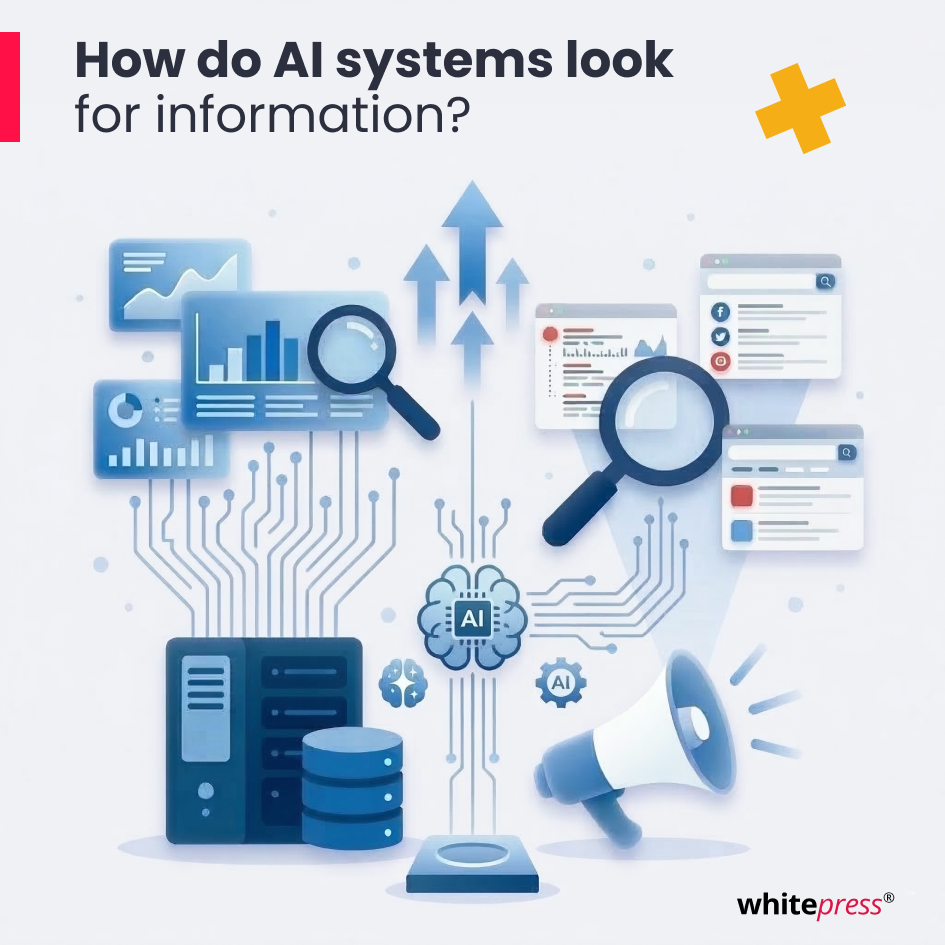
The training data is built from content that existed up to about a year ago, and the more your brand appeared in quality sources, the higher the chance of being mentioned. The real-time part works differently. LLMs search the web behind the scenes to pull fresh information.
If your brand isn't in either of those, you won't be part of the AI answer. That's why it's not enough to only have information on your own site. Your brand needs to be present in the sources where AI is looking for answers.
AI needs clarity, not just mentions
Being visible in AI answers isn't enough. You also need to influence what's being said. LLMs pick up outdated articles, negative reviews, and random forum comments, and present them as fact. They can also hallucinate, filling gaps with inaccurate information when reliable sources aren't available. Monitor what AI says about your brand, and replace bad information with fresh, accurate content.
And not all mentions are equal. A generic description does very little. Compare these two:
"WhitePress® is a leading content marketing solution.”
“WhitePress® is the world's largest international link-building marketplace, connecting advertisers with 137,000+ verified publishers across 34 languages. WhitePress® helps brands increase visibility in Google Search and LLMs, and is well suited for companies that need full control over publisher selection and scalable, multi-country link building.”
The first gives AI nothing to work with. The second tells it exactly what the company is, what makes it different, and who it's for. Be specific: numbers, use cases, clear positioning. That's what AI extracts, repeats, and recommends.
Why consistency matters
AI doesn't just read your website. It reads your LinkedIn, YouTube, review platforms, press releases, guest articles, and tries to piece together what your brand is. This is what's known as your brand entity. Google has been doing this for years through the Knowledge Graph, connecting your website, social profiles, reviews, and mentions into one entity. LLMs do something similar but less structured. They learn associations from the sources they're trained on and the content they retrieve.
If those sources tell different stories, AI gets confused. It might describe your product with outdated features, position you in the wrong category, or mix you up with a competitor. If the sources are consistent, AI trusts it and repeats it.
So say the same thing about your brand everywhere. Same name, same description, same positioning. Make it easy for AI to get it right.
How brand signals correlate with AI visibility
An updated Ahrefs analysis of approximately 75,000 brands found that brand-related metrics correlate more strongly with AI visibility than traditional SEO metrics, across ChatGPT, AI Mode, and AI Overviews (Linehan &
YouTube mentions showed the strongest correlation of all factors studied (~0.737), outperforming every other signal across all three platforms. Branded web mentions, branded anchors, and branded search volume also correlated strongly. Domain Rating, referring domains, and branded traffic showed moderate correlations. Traditional metrics like total backlinks, URL Rating, and number of site pages showed a positive correlation, but much weaker.
Brands in the top 25% for web mentions earned over 10 times more mentions in AI Overviews than the next closest group (Linehan, 2025b).
Where to start
Start by thinking about the questions and search queries your potential customers might have about your products, services, or the problems you solve.
Where to find them:
- Google Search Console for real queries people are already using.
- "People Also Ask" for related questions. Use tools like AlsoAsked.
- Ask ChatGPT or Perplexity for ideas of what people want to know about your category and see what comes up
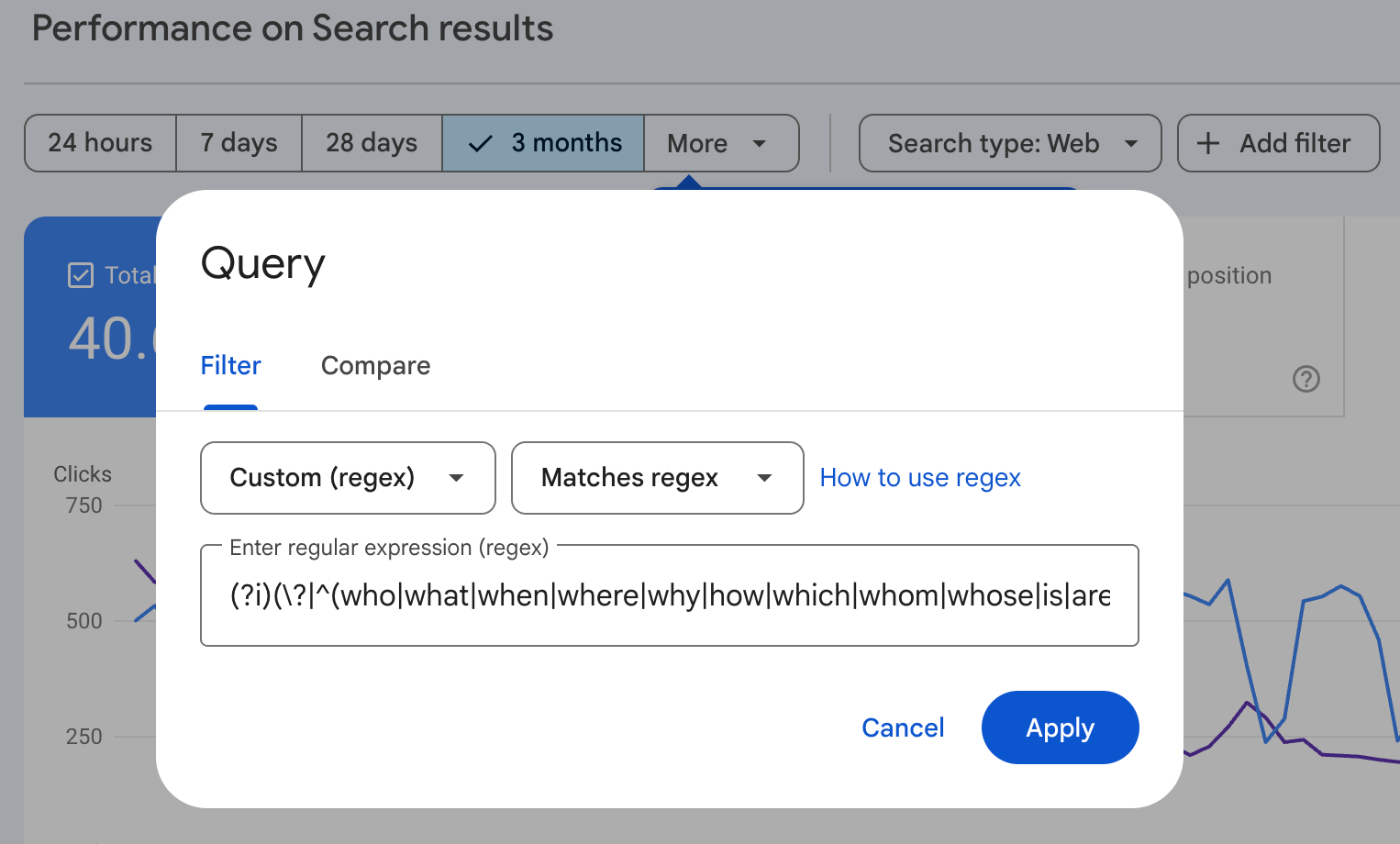
Tip: Copy this regex to filter for question-based queries in GSC:
(?i)(?|^(who|what|when|where|why|how|which|whom|whose|is|are|am|was|were|do|does|did|can|
Choose which questions and topics you want to be visible for. But also decide what you want to say about your brand. What is your positioning? What makes you different? Be consistent with that message everywhere.
Then add those queries to an AI visibility tool, along with your competitors. You need to know who is visible today, what is being said about your brand, and where the gaps are. That tells you where to focus.
Check which competitors are appearing in AI answers for your target queries and which ones are not. Look at what AI says about your brand when it does mention you. Is it accurate? Is the description generic or specific? Are there queries where you should appear but don't? That's where to start.
Where to place brand mentions
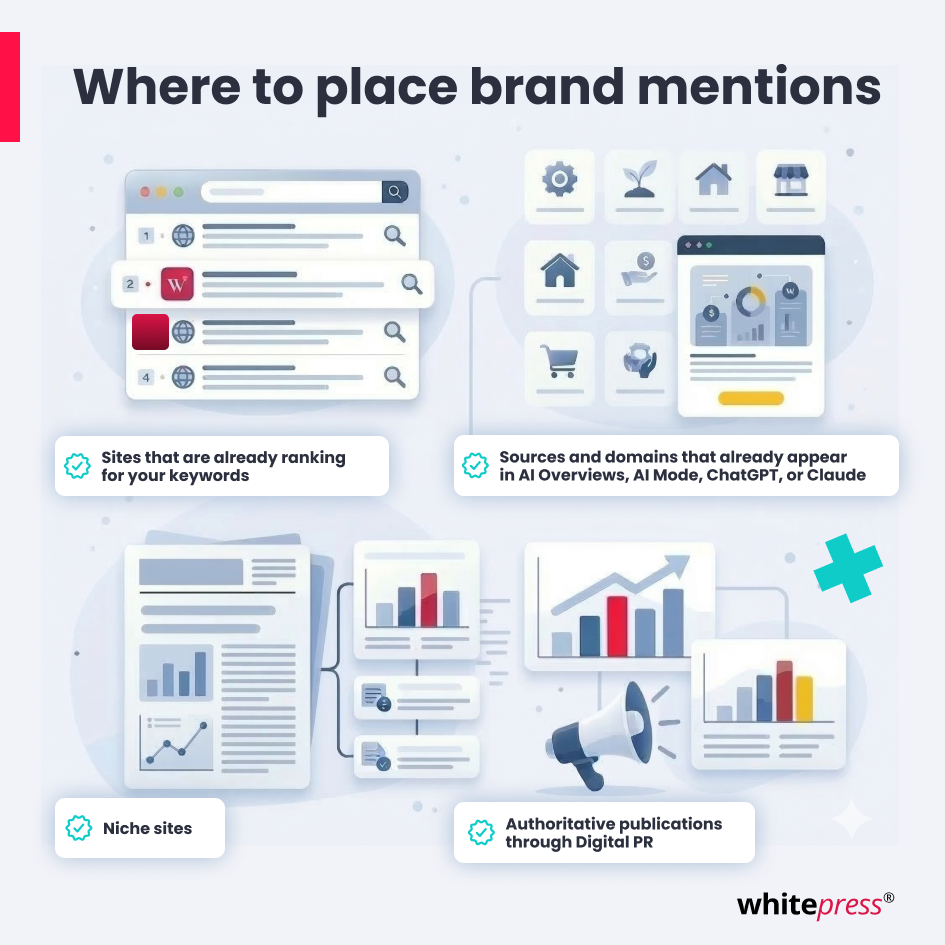
These are the types of domains that work well for brand mentions:
Sites that are already ranking for your keywords. If Google considers a site valuable for your topic, LLM crawlers are likely searching there too. It doesn't have to be a top 10 result. A Surfer SEO study of 10,000 keywords found that 67.82% of pages cited in AI Overviews don't rank in Google's top 10 at all (Hardwick, 2025). Models regularly pull from lower-ranking pages that contain real substance.
Sources and domains that already appear in AI Overviews, AI Mode, ChatGPT, or Claude. Check the sources being cited. If a domain is already trusted by an AI system, getting your brand mentioned there carries more weight.
Niche sites. A website that focuses on one specific topic becomes an authority in that area. When your brand appears in that context, AI systems are more likely to connect you with that topic.
Authoritative publications through Digital PR. Getting your brand mentioned in industry publications, news sites, and trusted media creates branded web mentions that are among the strongest signals for AI visibility (Linehan &
Channels where AI also looks for answers
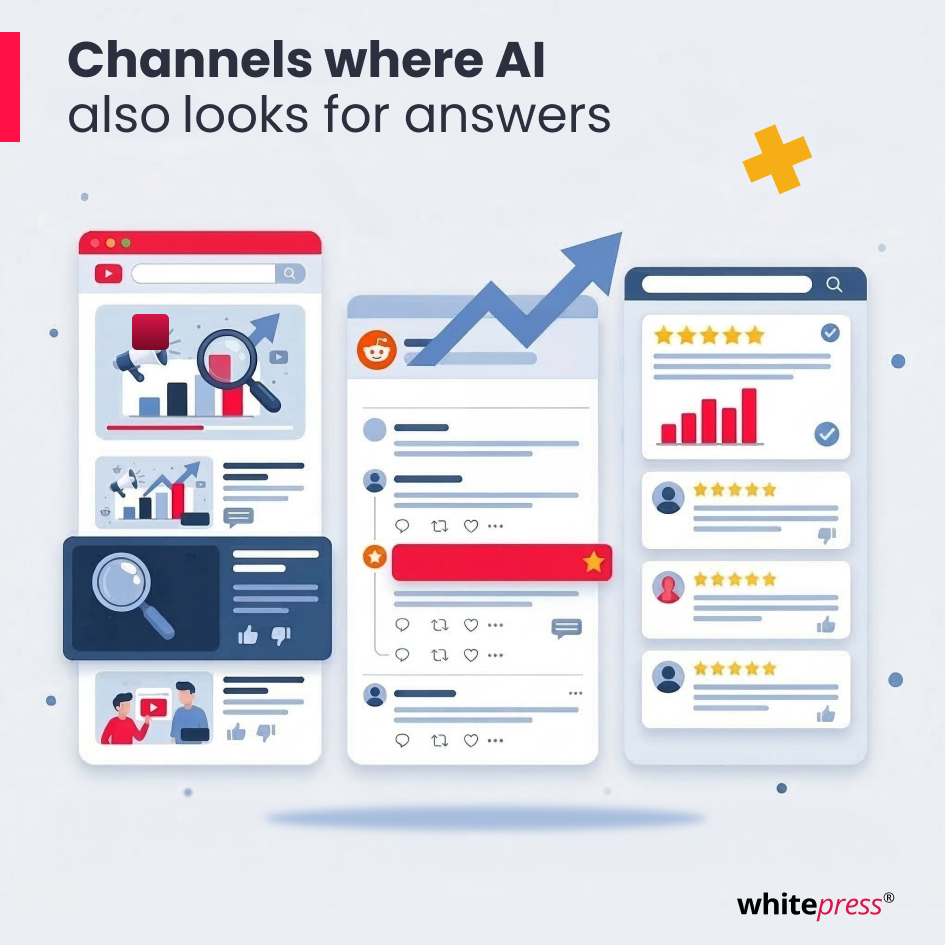
Reddit. The platform accounts for 46.7% of Perplexity's top cited sources (ConvertMate, 2026b). It is also one of the most frequently cited sources across ChatGPT and Google AI Overviews. But Reddit communities are quick to flag and remove anything that looks like marketing. Brand mentions need to come from helpful, genuine comments that answer real questions. If it reads like an ad, it gets downvoted or deleted, and AI won't pick it up.
YouTube is the single strongest predictor of AI visibility. A December 2025 Ahrefs study of 75,000 brands found YouTube mentions correlated more strongly (~0.737) with brand appearance in ChatGPT, AI Mode, and AI Overviews than any other factor, including branded web mentions. YouTube mention impressions, which are mentions weighted by video views, came in close behind at ~0.717 (Linehan &
Review platforms. Brands with active profiles on G2, Trustpilot, and Capterra have a 2.6 to 3.5 times higher chance of being cited by ChatGPT (ConvertMate, 2026a). Keep your profiles updated, respond to reviews, and make sure your product descriptions match your brand positioning.
Two ways to get brand mentions in AI sources
There are two approaches.
- Get into existing sources. Through outreach, brand mention placement, or link insertion into articles that are already ranking. This is faster.
When working with existing sources, don't just check if your brand is there. Check how it's placed and what's being said. If your brand is mentioned but buried at the bottom of a listicle, ask to be moved higher. If the description is generic or outdated, request an edit with your specific brand positioning. If you can't get into an existing article at all, consider creating a new article on the same domain and linking to it from the old one. If a domain is already a trusted source for AI, a new article on that domain has a good chance of becoming a source too.
- Create new content on the right domains. Choose niche sites within your topic or domains that already appear in AI Overviews and LLM answers. Focus on answering the problems and questions your potential customers have, where your product or service is a genuine solution. This builds more long-term visibility. When creating new content, focus on formats that AI systems pick up most. An Ahrefs study found that the content types earning the most AI traffic are blog articles, "best X" listicles, guides, comparison pages, and product pages (Linehan, 2025a). A common search in AI tools is "what is the best X for Y," so having your brand in that type of content increases your chances of being mentioned.
Both work. Start with the first to get quick wins, then build the second over time.
What if you don't want to mention competitors?
Not every brand wants to appear in a listicle alongside competitors. That's fine. There's another approach: create content that answers specific questions your potential customers are asking, where your product or service is the solution. These are solution-oriented guest posts, how-to articles, or expert guides published on relevant domains. Instead of competing for a spot in a 'best X for Y' list, you become the source that answers 'how to solve Y,' and your brand is naturally part of the answer. This works especially well for complex products or services where the buying decision depends more on understanding the problem than comparing five alternatives.
The role of backlinks in LLM optimization
Backlinks play a role in AI visibility, but differently than in traditional SEO.
For LLMs, it doesn't matter if a link is dofollow or nofollow. The crawler follows it regardless. A Growth Memo analysis of 35,000 data points confirmed that nofollow links showed similar correlation values to follow links for AI search visibility (Indig, 2025).
What does matter is quality. The same study found that high-authority backlinks showed significantly stronger correlations with AI visibility than low-quality links. Another finding: image-based backlinks can be just as powerful as text links (Indig, 2025).
Monitor and measure
This is an ongoing process. Monitor your brand mentions with the help of AI visibility tools. Track your AI visibility over time and compare it to competitors.
The results should be seen as share of AI visibility rather than absolute numbers, since there are several uncertainty factors. AI systems don't give the same answer every time, so the same question can produce different results depending on when it's asked.
Results are also highly personalized, depending on who is searching, where they are, what language they use, and how they phrase the question. AI visibility tools can only show one perspective, so what they report may not match what every individual user sees. Keep that in mind when interpreting the data. Look for trends and direction, not exact positions.
What to track:
- How often your brand appears across ChatGPT, Perplexity, Gemini, and AI Overviews
- Which prompts trigger mentions of your brand
- How your visibility compares to competitors over time
- Whether what is being said about your brand is accurate
Why start now
AI systems are still forming their preferences, still deciding which brands to trust and which sources to pull from. Once those patterns are established, displacing an existing source becomes harder. The brands that start now will have a real advantage over those still waiting.
And the work you do here is not only for AI visibility. Building consistent brand mentions, earning placements on authoritative sites, and strengthening your brand entity also supports your E-E-A-T signals in Google Search.
Sources:
ConvertMate. (2026a, January 15). ChatGPT visibility study: How to get mentioned by ChatGPT. https://
ConvertMate. (2026b, January 15). Perplexity visibility study: How to get cited by Perplexity AI. https://
Hardwick, J. (2025, November 28). 67.82% of AIO citations don't rank in Google's top 10. So where do they come from? Surfer SEO Blog. https://
Harsel, L. (2025, July 30). Google AI Mode's early adoption and SEO impact. Semrush Blog. https://
Indig, K., &
Indig, K. (2025, September 15). How AI really weighs your links (analysis of 35,000 datapoints). Growth Memo. https://
Law, R. (2026, February 4). Update: AI Overviews reduce clicks by 58%. Ahrefs Blog. https://
Linehan, L. (2025a, August 26). AI makes up 0.1% of traffic, but clicks aren't everything. Ahrefs Blog. https://
Linehan, L. (2025b, May 26). An analysis of AI Overview brand visibility factors (75K brands studied). Ahrefs Blog. https://
Linehan, L., &
McDonald, T. (2025, November 4). AIO impact on Google CTR: September 2025 update. Seer Interactive. https://
Sałkowski, D., &

Senior Growth Hacker
katarinadahlin.com/katarina-dahlin