AI in Email Marketing: Stop Asking AI to Write Emails and Start Integrating It into Your Workflow
(9 min. read)
Successful teams use AI to make better decisions. For example, finding insights into customer feedback, catching issues before launch, or turning campaign data into smarter next steps. In this article, I suggest that you look at AI as if it’s your decision-support system. You’ll learn where AI improves decisions, how to build it into your workflow, how it helps you scale judgment, and which decisions AI shouldn’t make.
You're Measuring the Wrong Thing: Speed Isn't AI's Biggest Benefit
Think about how many decisions a marketer makes before launching a campaign. Which pain points to address? Does the email align with a brand voice across different markets? Which assumptions should be tested? What to do if a campaign fails? These decisions don’t always take much time, but they shape campaign performance.
Here, AI helps strengthen the decision-making process by helping teams:
- spot inconsistencies across dozens of campaigns so they don’t ruin the subscriber experience. AI will easily locate differences in terminology, CTAs, or messaging that can confuse subscribers;
- find recurring themes from customer feedback (e.g., customer reviews, support conversations, or survey responses). If your customers often struggle to understand a single feature, address it during the next educational campaign;
- suggest testing opportunities based on campaign goals that humans might overlook. After analyzing your data, AI can suggest testing two different value propositions for the same audience;
- keep messaging consistent across channels;
- help teams run sophisticated lifecycle programs without growing workload.
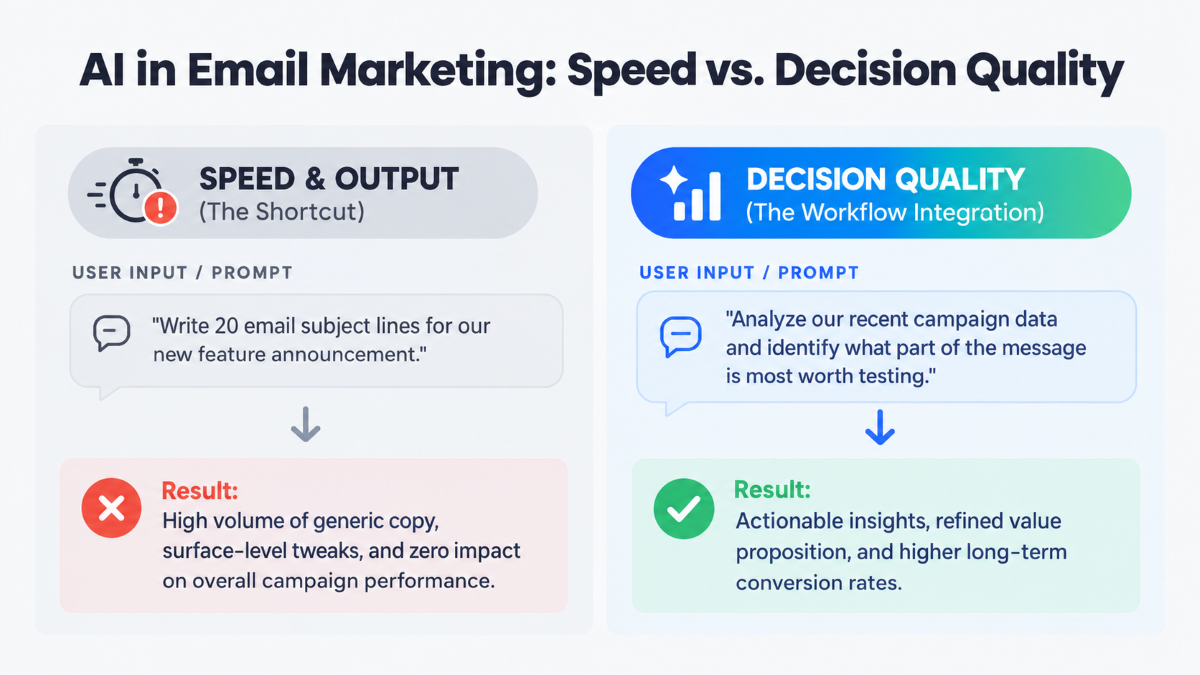
A practical approach we’ve found useful is to ask AI what is worth solving before asking it to create something. For example, instead of requesting 20 subject lines, give it the campaign goal and recent performance data and ask which part of the message is most worth testing.
You may end up realizing that the bigger opportunity isn't in the subject line but in the value proposition, audience segment, or CTA.
The key point here is that you shouldn’t treat AI as a fast copywriter. Think of it as a decision support system. This system will offer relevant information when marketers need to make crucial choices.
Where AI Improves Decisions Across the Email Workflow
Every campaign is the result of dozens of decisions you made before, during, and after production. AI can support these decisions with data and context.
Before Production
Your campaign’s quality is determined before your team starts working on an email copy or layout. What bothers your subscribers? Which messages deserve attention? How does the campaign fit into the customer journey? All of it has had a grand impact.
Here’s how AI can support you at this stage:
- summarize customer research and support chats;
- analyze reviews to expose regular complaints or questions;
- group subscribers into segments based on their behavior;
- prioritize messages according to your goals and subscribers’ needs.
For instance, when launching a new feature, don’t ask AI to craft an announcement email. A much better idea would be to request it to analyze recent feedback and find three big challenges your customers want the feature to solve.
The answer quality will depend heavily on the context you give AI. In our experience, it works much better when you give the materials it needs to understand the campaign: customer feedback, product information, audience characteristics, previous emails, and your brand guidelines.
Asking AI to 'write an email about our new feature' without this context will give you a generic result. Offer it the evidence first, and the output becomes much more useful.
Decision: What should we send, and why will it matter to our subscribers?
During Production
Now, when your strategy is clear, AI can become your production assistant. It can review marketers’ work quickly and consistently.
During this stage, AI can help you:
- generate content variations for different segments;
- check consistency across emails, landing pages, and other channels;
- localize emails for different languages and cultures, keeping your tone of voice;
- find accessibility issues and offer solutions;
- detect missing personalization, inconsistent CTAs, broken links, or other QA problems.
Decision: Is this campaign ready to send?
After Launch
It’s clear that a campaign ends with checking important metrics like opens, clicks, and conversions. But it’s also vital to analyze why those numbers change and what they should affect next.
In post-campaign analysis, AI can help you:
- interpret results alongside historical trends;
- identify unusual patterns or if your audience behaved unexpectedly;
- suggest hypotheses to test during upcoming campaigns;
- summarize key learnings to suggest future experiments.
At first, it may seem like replacing human analytical thinking, but that’s not the point. Your team can actually take time to discuss what the results mean and how to act on them instead of compiling endless dashboards.
Decision: What should we improve in the next campaign?
How AI Helps You Scale Judgment
Here, I’d like you to think about a typical email marketing team. Every day, people manage promo newsletters, onboarding sequences, transactional emails, abandoned cart reminders, and re-engagement campaigns simultaneously. Each email should be aligned with brand guidelines, speak to the correct subscriber segment, and be accessible. Even a seasoned team may struggle to maintain this quality across hundreds of emails.
Well, unlike humans, AI doesn’t get exhausted checking the 50th email for broken links or off-brand tone of voice. It just applies the same analytical process every time, helping your team maintain quality and consistency.
For example:
- review large campaign volumes for inconsistencies in tone, messaging, or CTAs;
- catch patterns in campaign performance that are tricky to spot by manually comparing reports over several months;
- highlight frequent accessibility or QA issues in time, so they don’t become habits across the team.
AI doesn’t scale creativity, but it certainly does scale consistency. The tool won’t decide for you how to speak to your audience or which campaign deserves priority. But it surfaces data that is tough for human specialists to process consistently.
Three Decisions AI Still Shouldn't Make
AI is becoming more capable every day. It’s tempting to let it take on strategic tasks, but high-impact decisions need human judgment. While AI can analyze patterns and generate recommendations, it doesn’t understand your company’s shifting priorities, relationships with customers, or the trade-offs behind every campaign.
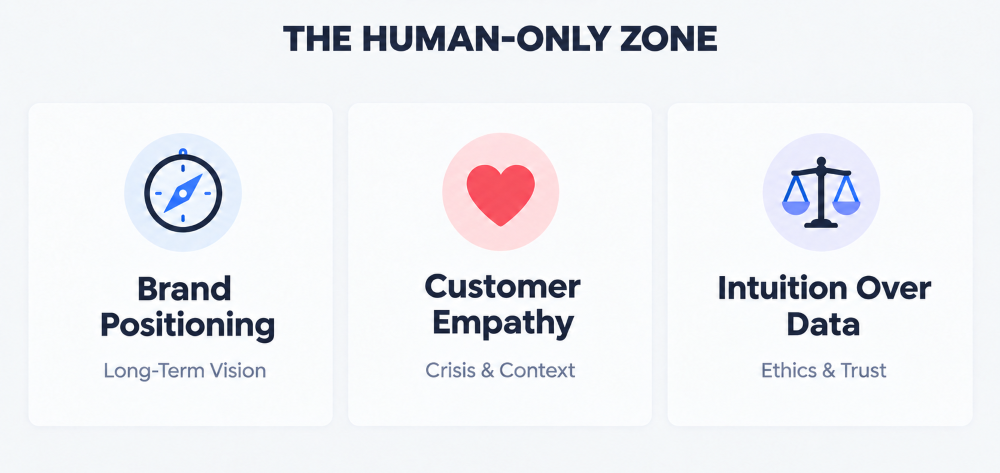
Brand Positioning
AI is great at learning your tone of voice, adapting copy to different subscriber segments, and generating text that sounds like it’s written by your experienced copywriter. But don’t let it decide how your brand should evolve.
Should your messaging become more technical to appeal to enterprise buyers? Is it time to shift from feature-led communication to customer success stories? Should you position your product as the premium option in the market or compete on simplicity?
Can you use AI to support these business decisions with research or competitive analysis? Absolutely. But ensure that the direction comes from people who understand the company’s vision and goals.
For day-to-day content work, we’ve found it useful to give AI examples of what your brand actually sounds like instead of relying on a written description of your tone of voice alone.
Keep a small library of approved emails, product messaging, audience descriptions, terminology, and brand guidelines. When AI has access to these examples before generating or reviewing copy, there is much less room for generic phrasing.
Customer Empathy
Marketing doesn’t work in a vacuum, and every campaign is affected by what’s happening in your subscribers’ lives and in your business. Imagine that your service just suffered a massive outage. Launching a promo campaign at this time may damage customer trust, even if it’s already meticulously planned and put into your marketing calendar.
The same goes for industry crises, sensitive global events, or moments when people expect your support. AI doesn’t genuinely understand relationships. It’s your marketers who know when to pause a campaign or recognize what customers are experiencing, even if it means straying from the planned route.
Knowing When the Data Isn't Enough
Sometimes, the highest-performing subject line feels off, or an aggressive promo strategy brings quick revenue but weakens long-term trust. Or maybe a campaign looks impeccable during your brainstorming meetings but doesn’t feel right given changing business goals.
Data can’t decide everything, so marketers shouldn’t follow them blindly. Instead, it’s better to challenge them. Combine performance metrics with business context, develop intuition through experience, and pay attention to industry conversations.
AI is here to make marketers better informed and to help them keep track of what’s happening. But deciding how to act on it is up to you.
Build AI into Your Workflow
For now, you probably have a set of prompts that work for you (e.g., creating email layouts, generating copies, or brainstorming campaign ideas). They surely save time, but teams often treat AI as a standalone tool rather than as part of the workflow. Ask yourself a question: 'Which recurring decisions in my workflow can I support by AI every time?'
Start with regular campaigns. They are the easiest place to build an AI workflow because the inputs and outputs are predictable. If you have a weekly newsletter, define exactly what AI should return each time: a headline, summary, category, CTA, and alt text.
Structured outputs are easier to review and reuse than a block of free-form copy, and you can connect them to other tools in an automated workflow.
Once the process is stable, tools such as Zapier, Make, or n8n can connect AI with your existing data sources, CMS, CRM, or email platform. Start with one repeatable task, make the output reliable, and then expand the workflow.
Your AI-enabled email workflow might look like this:
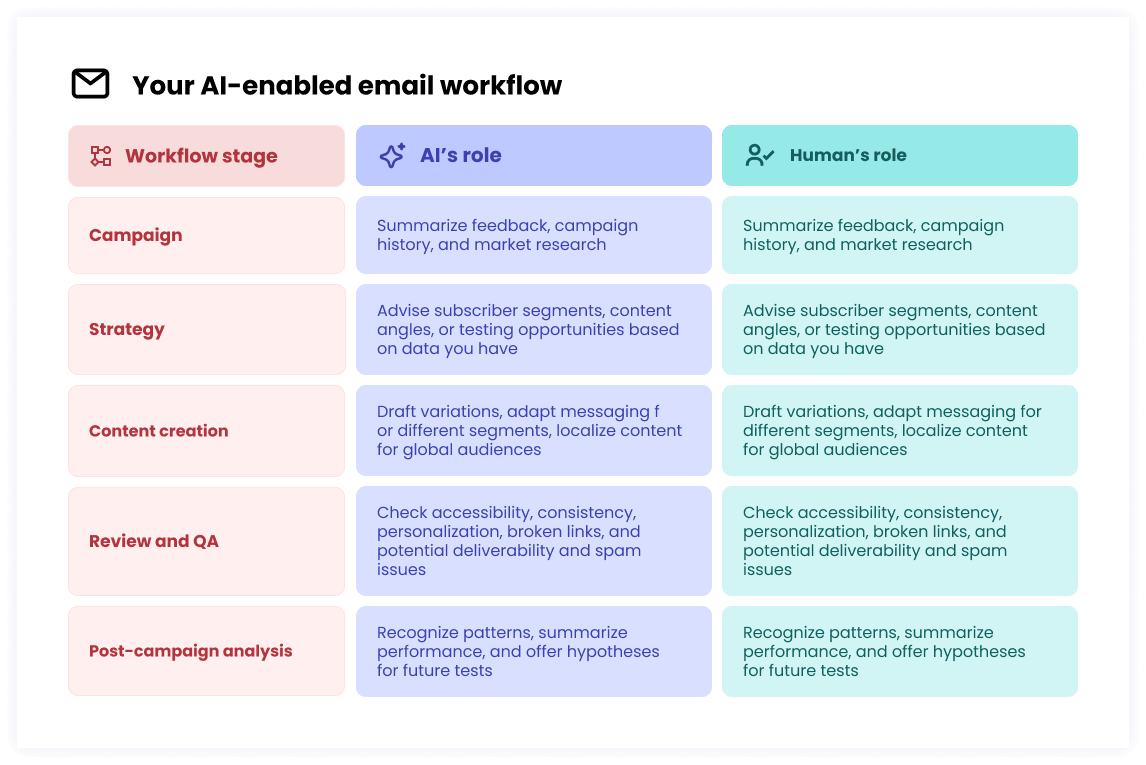
Check the pattern here: AI provides information and consistency at every stage, and a human specialist makes the decisions that require business context and creativity.
What’s good is that such an approach makes AI adoption repeatable. There’s no need to rely on each team member’s memory to remember the right prompts or experiment with AI tools. Every campaign benefits from the same research, review, and analysis steps, no matter who creates it. And if a team member responsible for a certain email creation task is unavailable, another employee can step in and pick up where they left off.
Wrapping Up
Successful teams are redesigning their workflows so that AI supports better decisions at every stage. It’s a good way to reveal insights that humans might miss, maintain consistency, and spend more time on a strategy.
We can’t hide from AI evolving every day. Our main task as email marketers is to mix AI’s ability to process information with the judgment, creativity, and empathy that only humans can bring. In the end, it’s vital to build a workflow where technology strengthens human expertise instead of trying to replace it.

Content writer and blog editor at Stripo