(6 min. read)
Why did OpenAI introduce ads to ChatGPT?
The introduction of ads to ChatGPT sparked plenty of discussion. Journalists were quick to point out that back in 2024, OpenAI co-founder and CEO Sam Altman described advertising as a “last resort” (MarketWatch):
I kind of think of ads as like a last resort for us as a business model.
So what changed? One major factor is revenue. Advertising gives OpenAI another source of income to help fund the significant costs involved in developing and running AI technology (Reuters).
From the outset, analysts highlighted two sides to the move. On the one hand, advertising represents a significant commercial opportunity. ChatGPT has around 800 million weekly users, with more recent figures putting that number at one billion. On the other hand, introducing ads could affect users’ trust in the platform and potentially encourage some of them to explore alternatives.
OpenAI announced its plans on 16 January 2026, initially testing ads in the United States for users on the Free and Go plans (OpenAI).
What are the key features of ChatGPT ads?
OpenAI highlights three key principles:
- independence
- privacy
- user control
What does this mean in practice? ChatGPT’s answers are generated independently of advertising. Ads do not influence the responses users receive, helping to avoid potential conflicts of interest.
Your conversations remain private, and your data isn’t shared with advertisers - or, put simply, sold to them.
Users have control over how their data is used for advertising purposes. They can, for example, turn off ad personalisation and clear the data used to personalise the ads they see.
Users can also choose between plans that include ads and ad-free subscription options (OpenAI).
How are ads displayed in ChatGPT?
Do these newly introduced ads get in the way when using ChatGPT? Not really.
Ads are clearly labelled and displayed separately from ChatGPT’s answers, making it easy to distinguish sponsored content from the response itself.
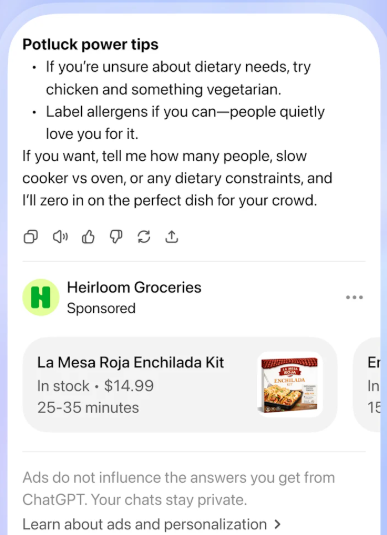
Example of an ad displayed in ChatGPT. Source: ads.openai.com
Users can also find out why a particular ad was shown to them. They can hide ads they are not interested in and provide feedback explaining why the ad was not relevant.
ChatGPT ads in UK: what’s the current situation?
In August 2026, OpenAI expanded ChatGPT ads to UK as part of a wider rollout across 31 European markets.
Ads are shown to users on the Free and Go plans, while paid subscription plans such as Plus and Pro remain ad-free.
Which countries offer ChatGPT advertising?
ChatGPT advertising is expanding across international markets, with advertisers now able to reach users in countries across several continents.
These include:
- North America (the United States, Canada and Mexico)
- South America (Brazil)
- Europe (including the UK, Poland and France..)
- Asia (including South Korea and Japan…)
- Africa ( Algeria, Egypt, Morocco and Tunisia)
- Oceania (Australia and New Zealand)
How many businesses have already tried advertising through the ChatGPT mobile app in the US? Data from July 2026 puts the figure at more than 820 advertisers (Business Insider).
Globally, OpenAI says tens of thousands of advertisers are already using its advertising platform.
ChatGPT Ads: how can you advertise?
Getting started involves a few simple steps:
- Go to ads.openai.com.
- Click Sign up.
- Open Ads Manager.
- Create a campaign by choosing your objective and setting your budget.
- Add your ad details.
- Launch your campaign.
Once your campaign is live, you can monitor its performance and make adjustments to optimize your results.
You can also contact an advertising expert if you need additional support, especially if you represent a larger company. Simply fill in the form available at ads.openai.com
- first name
- last name
- work email address
- job title
- company name
- company website
- country where the company is based
- countries where you want to advertise
- organisation type (Agency/
Advertiser/ Technology Partner/ Other) - annual advertising spend
Once all the required information has been entered, click Submit.
ChatGPT Ads: what can advertisers expect?
AI has changed the way people look for information online. ChatGPT is now used for a wide range of everyday tasks, including researching products and making purchasing decisions.
For advertisers, this creates a new opportunity to reach potential customers at a point when they are already exploring specific products or services.
Amy Adams, Vice President of Media at Best Buy, notes that customers are increasingly turning to ChatGPT as part of their purchasing journey and describes advertising on the platform as an efficient way to reach them.
Garima Singh, AI Paid Media Manager at VistaPrint, has also highlighted the platform’s ability to reach new audiences based on the results the company has seen.
Gerardo Soto, Vice President of Media and Sports Marketing at Lowe’s, described the company’s experience as one of the early partners in the ChatGPT ads pilot:
As one of the first partners in the ChatGPT ads pilot, we’ve been able to test and learn in a new environment that brings together discovery, research and shopping.
According to Soto, the pilot has provided useful insights into customer behaviour alongside promising early results.
However, early experiences have not been universally positive.
Casey Burridge, a marketer at GravityKit, shared results from a campaign that generated relatively inexpensive traffic but little meaningful engagement and no conversions.
The campaign delivered:
- total spend: approximately $550
- impressions: around 12,800
- CTR (click-through rate): 1.7%
- CPC (cost per click): $2.57
- purchases: 0
The campaign was originally scheduled to run for 34 days but was stopped after around three weeks due to its performance (Casey Burridge’s blog).
How are ChatGPT ads different from traditional online ads?
Two characteristics stand out:
- they are more contextually relevant
- they are less intrusive
Here’s a simple example.
Imagine someone is looking for new furniture for their living room and asks ChatGPT for advice. Based on the conversation and the preferences they have shared, ChatGPT can suggest suitable options. A relevant sponsored offer may then appear below the response.
This means that ad relevance can be informed by the context of the conversation rather than relying solely on keywords.
The format is also designed to be less intrusive. Sponsored content is clearly separated from ChatGPT’s response instead of appearing as a pop-up or taking over a large part of the screen, as can happen with some traditional forms of online advertising.
How much could OpenAI make from ChatGPT ads?
In August 2026, OpenAI reported that its advertising business had reached an annualised revenue run rate of $1 billion (Reuters).
In simple terms, if advertising revenue continued at the same pace for 12 months, it would amount to around $1 billion over the year.
Advertisers outside the US are also adopting the platform, with small and medium-sized businesses representing an important part of OpenAI’s advertising business (OpenAI).
ChatGPT advertising: summary
Advertising gives OpenAI an additional revenue stream while introducing a new format for brands looking to reach potential customers.
From a user perspective, the format is relatively unobtrusive: ads appear separately from ChatGPT’s answers and can be relevant to the context of the conversation. In some cases, this could make it easier to discover suitable products or services and shorten the purchasing journey.
Can ChatGPT ads help businesses reach new audiences effectively? It is still too early to give a definitive answer. Early advertiser experiences show that results can vary considerably.
For businesses, ChatGPT ads offer another channel worth testing, but - as with any advertising platform- running a campaign does not guarantee an increase in sales.