(8 min. read)

This article was written by Bart Magera, CEO Mojo Links.
What Is Entity SEO from a Link Builder's View?
Entity SEO is Google's reading of a link as an entity-overlap event between a source page and a target page. The graph layer records the connection. The entity layer reads whether the connection carries meaning. For link builders, the second reading now decides whether the placement pays off.
With this context, Entity SEO does not mean schema markup. It means the evaluation Google runs after it has crawled the link, where it asks whether the source entity and the target entity belong to overlapping topical neighborhoods on the Knowledge Graph.
The Knowledge Graph reads source-target pairs as entity-overlap events. Two pages joined by a link become a data point about how those two entities relate. That data point either reinforces the target's entity claim or contributes noise.
The graph and the entity layer run in parallel. Both produce scores. The mistake operators make is treating graph scores as if they answered entity-layer questions. They do not.
Why Does Topical Fit Now Beat Domain Rating?
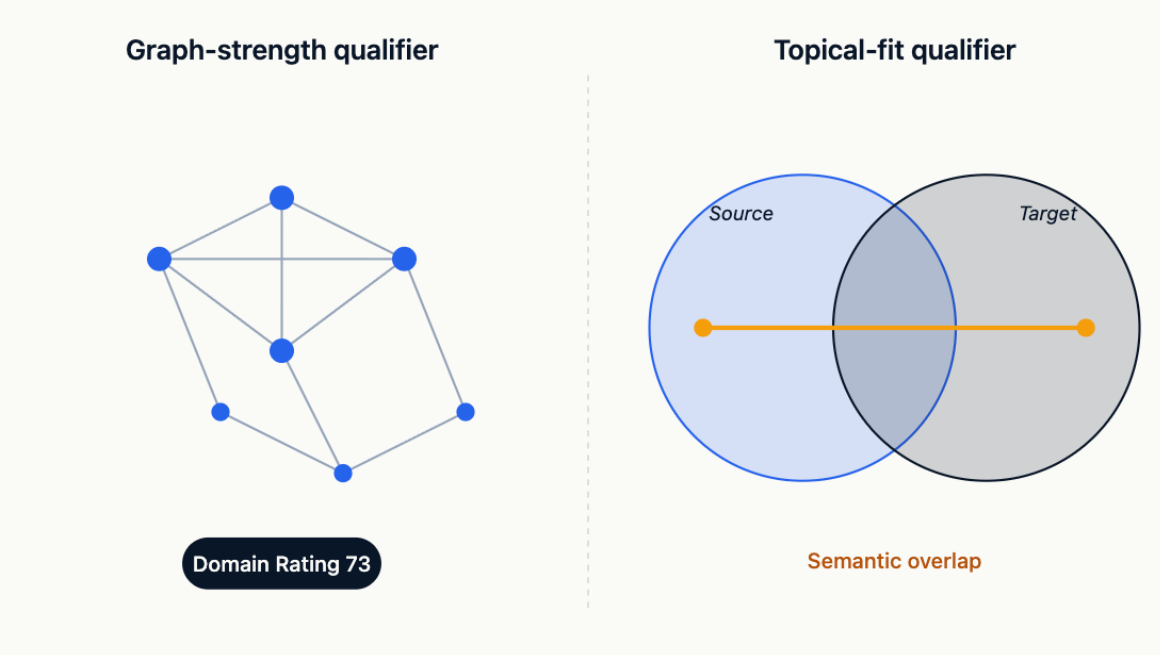
Topical fit beats Ahrefs Domain Rating as a qualifier because the entity layer evaluates semantic overlap while Domain Rating measures recursive graph strength. Ahrefs is honest about the metric's scope. The misuse happens when operators treat a graph score as a semantic qualifier on a placement decision.
Ahrefs has published the definition. Ahrefs Domain Rating is a 0-100 logarithmic score weighted by referring-domain quantity and referring-domain quality, with the calculation defined recursively across the graph.
The metric captures graph position. It does not read what the linked pages are about. Moz Domain Authority and Majestic Trust Flow share the same diagnosis. They are graph metrics. None of them read topical alignment, anchor coherence, source context, or target relevance.
Most working link builders I spoke with after the CMSEO 2025 and Link-Building Mastery sessions agreed the pattern matches what they see in their own campaigns. The graph still moves. The ranking lift that used to follow has become intermittent. The countable metric outlived its predictive power, and the reporting structures of the industry have not caught up.
|
Graph-strength qualifier |
Topical-fit qualifier |
| Measures recursive backlink count and quality |
Measures semantic overlap between source and target |
|
Examples: Ahrefs Domain Rating, Moz Domain Authority, Majestic Trust Flow |
Examples: entity proximity, anchor coherence, contextual alignment |
|
Predicts graph position |
Predicts ranking lift in the entity era |
|
Useful as a floor filter against spam |
Useful as the qualification layer that decides the placement |
How Does Google Read a Link as an Entity Signal?
Google reads a link as a three-layer signal: the source page's topical context, the anchor phrase as the bridge between meanings, and the target page's primary entity. Misalignment in any single layer weakens the signal. Misalignment across all three layers reduces it to near zero.
Source page context contributes paragraph-level relevance, not just domain-level. A topically aligned domain can still publish a guest post that sits outside its core neighborhood, and the link inside that post inherits the host paragraph's context, not the domain's headline topic. Anchor coherence bridges source meaning and target entity. The anchor phrase that mirrors how the target page describes itself passes the cleanest bridge. Generic anchors propose no bridge. Exact-match anchors expose manipulation.
I broke the three layers down at the linguistic level in the anatomy of a relevant link, where I separate reference from sense the way Saussure does. For the qualification work in this piece, what matters is that the three layers each carry a signal and that any one of them can weaken the placement.
What Qualifies a Link in the Entity Era?
A link qualifies on four properties: topical proximity between source and target entities, contextual alignment inside the source paragraph, anchor coherence with the target entity, and topical concentration of the source domain. All four properties are semantic. None are graph properties. The graph cannot see any of them.
- Topical proximity. The distance between source and target entities on the Knowledge Graph. A legal SaaS linking to another legal SaaS sits close. A general business publication linking to a legal SaaS sits at moderate distance. A fitness blog linking to a legal SaaS sits at maximum distance. Proximity is a gradient, not a binary.
- Contextual alignment. The specific paragraph hosting the link belongs to the same semantic neighborhood as the target. A legal industry domain publishing a productivity-themed guest post is not in legal context for the duration of that post. The link's value gets read at the paragraph level.
- Anchor coherence. The anchor phrase sits close to how the target page describes itself. Descriptive anchors that mirror the target's primary entity pass the cleanest signal. Generic anchors propose no bridge. Exact-match anchors carry penalty risk by exposing the manipulation.
- Topical concentration. The source domain stays inside one topical neighborhood across its body of publication. Concentrated domains signal vertical authority at the domain level. Broad domains signal breadth without depth and pass less equity at equivalent graph strength.
No productized tool I trust in 2026 scores all four automatically. The operator's read is still the signal. For the qualification work today, the operator does the reading.
What Does Silent Devaluation Look Like in a Campaign?
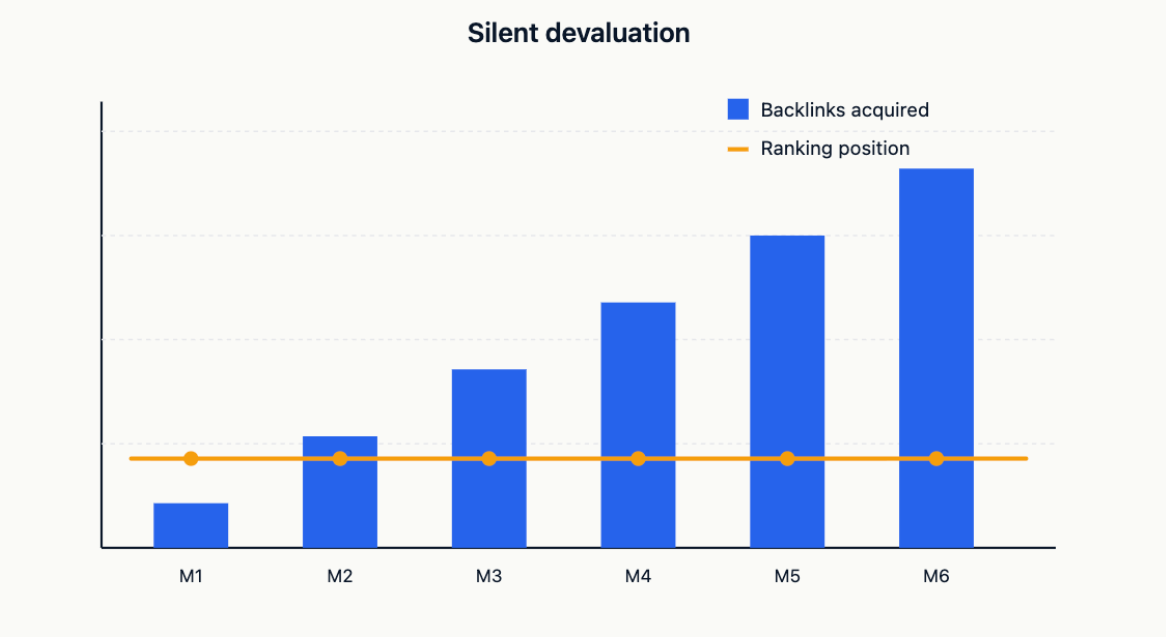
Silent devaluation is the pattern where backlink counts grow on schedule while rankings stay flat. No penalty notification arrives because no rule was violated. The links index. They report in dashboards. They sit there. The campaign produces nothing measurable on the ranking side.
Across the audits I run, the pattern shows up consistently. A site adds placements at the expected pace, the backlink count grows on schedule, the ranking lift never arrives. The site reads as topically noisy at the entity layer because the new links sit outside the target's neighborhood. The classification stays flat or weakens, because the surrounding signal is now noisier rather than stronger.
The reporting structure makes this worse. A team that reports on backlink count alone has a green slide every month while the traffic curve stays flat. Three quarters can pass before anyone audits the assumption inside the spreadsheet. By that point the budget is gone and the rankings sit where they started.
How Should a Link Builder Qualify Prospects in 2026?
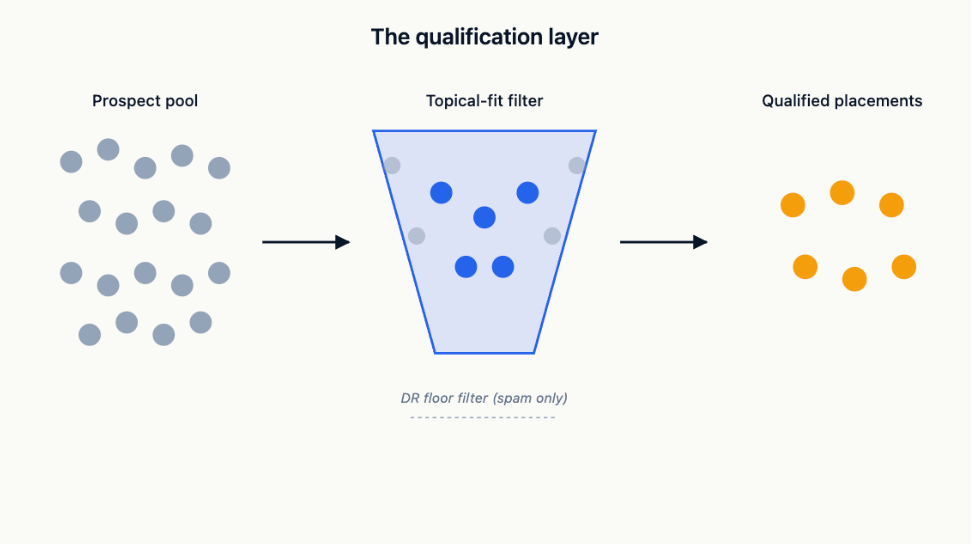
A link builder qualifies prospects by reading entity overlap first and graph strength second. The first question is whether the source domain sits inside the target's topical neighborhood. The second is whether the specific placement paragraph carries the right context. Domain Rating becomes a floor filter, not a qualifier.
The qualification work happens at the prospect level, before outreach. A prospect that fails the topical proximity read does not become a better prospect at higher Domain Rating. It becomes a more expensive irrelevant link. The qualification layer replaces DR-tier prospecting as the operating discipline of entity-era link work. The shift is not a content tweak. It is a change in the unit of value.
What Changes for Link-Building Pricing Models?
Pricing built on Domain Rating tiers reflects a graph-strength market. Pricing built on topical-fit qualification reflects an entity-era market. The unit of value shifts from a DR-tier placement to a topical-neighborhood placement. Agencies that hold the old unit deliver lower compounding ranking lift than agencies that have rebuilt their pricing around qualification.
The shift takes time because the old unit is countable and the new unit takes operator judgment to score. Countable units win inside agency reporting structures until the cost of staying with them exceeds the cost of changing. Operators who have already changed report compounding ranking lift on smaller link volumes. Operators who have not reported growing backlink counts and flat traffic. The market is sorting itself by which unit of value an agency prices.
Frequently Asked Questions About Entity-Fit Link Building
Is link building dead in the entity era?
No. Link building is structurally necessary for commercial-query rankings in competitive verticals. What is obsolete is the prospecting workflow that filters by graph metric alone. The work has not disappeared. It has moved upstream into qualification, where it now lives.
Does this apply to small sites or only established ones?
Both, and small sites feel the consequences faster. A large established domain has historical entity associations that buffer marginal devaluation. A small site has fewer associations, so each new link either reinforces the entity claim or wastes the placement. Topical-fit discipline matters more on smaller domains, not less.
How long until topical fit shows up in rankings?
60-90 days is the window where ranking lift becomes visible after a relevance reset. The first 30 days cover indexing and re-evaluation. The compounding effect on entity classification accumulates after that and continues strengthening over the following 6-12 months. Topical Authority is Historical Data multiplied by Topical Coverage, in the formulation Koray Tuğberk Gübür teaches, and both factors are time-dependent.

CEO Mojo Links