(9 min. read)
Why should you measure your brand's AI visibility?
If you're still wondering whether it's really necessary, the following statistics might convince you.
According to Semrush forecasts, traffic to websites from AI-powered search engines and tools could overtake traditional organic search traffic around 2028 (Semrush).
Figures from June 2026 show that AI Overviews reaches 2.5 billion monthly users, while AI Mode has more than 1 billion (Google). What's more, the number of queries in AI Mode has doubled every quarter since its launch in May 2025.
More than one billion people now use ChatGPT every week (OpenAI).
These figures are hard to ignore.
Brand visibility in AI responses vs AI referral traffic: what's the difference?
These are two distinct things. Brand visibility in AI refers to instances where your brand is mentioned in an AI-generated response – for example, in AI Mode or AI Overviews.
However, being mentioned doesn't necessarily mean your website will receive any traffic. That only happens when an interested user clicks through to your site.
AI referral traffic, on the other hand, refers to visits to your website that originate from AI-powered tools such as ChatGPT, Gemini, Perplexity and Claude.
Measuring brand visibility in AI: key metrics
The most important metrics include:
- Brand mentions
- Citations
- Visibility for specific prompts
- AI Share of Voice
- AI referral traffic
- Conversions
Brand mentions
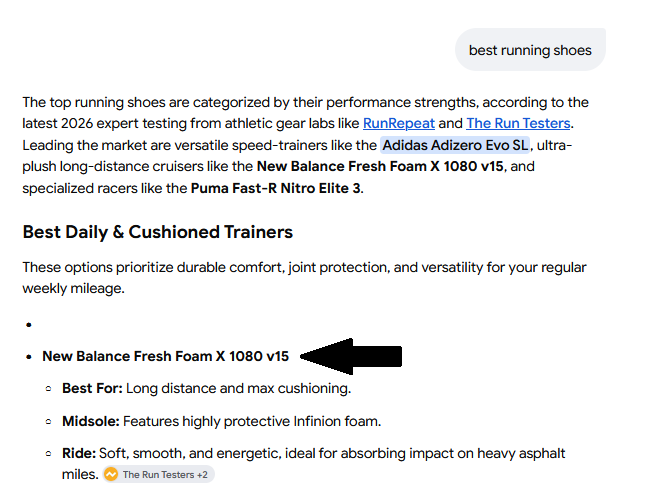
A brand mention occurs when an AI-generated response includes the name of a brand, product or another recognisable entity. It doesn't have to include a link to the brand's website.
In the context of AI, brand mentions cover references to your company that appear in responses generated by AI-powered tools.
Citations
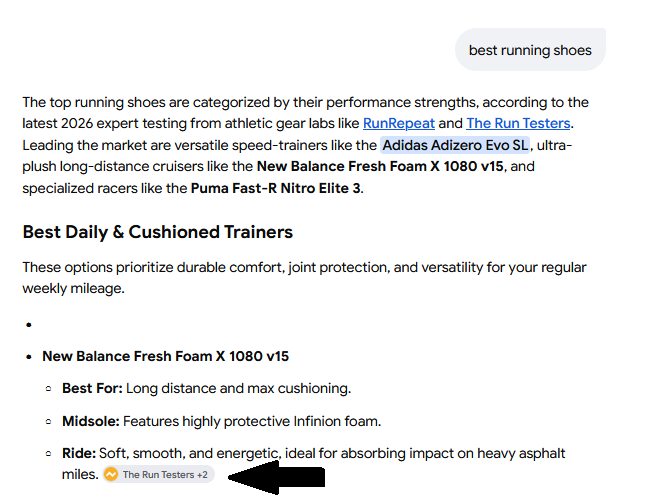
A citation occurs when an AI-generated response identifies a source used to produce the answer, such as a link to a website. This is the key difference between citations and brand mentions.
In AI search, a citation might be a link to a relevant website provided by a tool such as AI Mode. This makes things easier for users, who can follow the link directly and, for example, complete a purchase more quickly.
Citations also matter to brands. They increase online visibility and can drive additional traffic to their websites.
Visibility for specific prompts
This metric looks at whether your brand appears in AI-generated responses to particular user prompts.
It's worth remembering that the same question can produce different answers depending on:
- conversation history
- user location
- personalisation
- follow-up questions
- model version
- available web search results
- when the query is made
AI Share of Voice
AI Share of Voice measures your brand's visibility relative to competitors within a particular market category. The calculation can vary depending on the tool. One approach is to measure the proportion of mentions your brand receives out of all mentions of the brands being analysed.
In this case, the formula is:
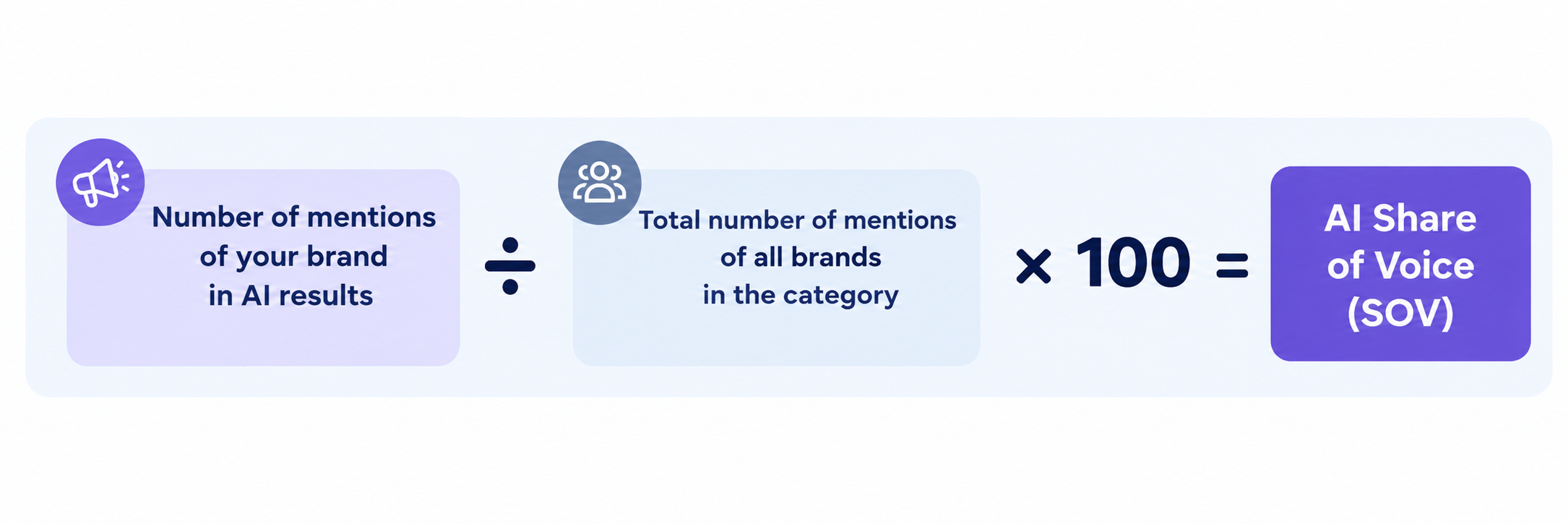
For example, if your brand receives 20 mentions out of a total of 100 mentions in its category, your AI Share of Voice is 20% (20 ÷ 100 × 100%).
AI referral traffic
This refers to visits to a website, such as an online shop, resulting from AI-generated responses in tools and features including AI Mode and AI Overviews. In other words, it's not just about appearing in AI-generated answers. A user also needs to click a link to reach your website.
Conversions
A conversion happens when a website visitor completes an action that matters to the business, such as purchasing a product or booking a service.
In the context of AI, citations that link directly to a website can help drive conversions.
How to measure AI visibility: the most important tools
There are several tools you can use to monitor AI visibility and referral traffic. However, they measure different aspects of a brand's presence in AI-generated responses and use different metrics. It's therefore important to understand exactly what each tool measures when interpreting the results.
Some of the most widely used tools include:
- Google Analytics 4 (GA4)
- Google Search Console
- Semrush AI Visibility Toolkit
- Ahrefs Brand Radar
So, how can you track traffic from AI? Let's look at these tools and their key features.
Google Analytics 4
With Google Analytics 4, you can measure and analyse traffic to your website.
Wondering how to track traffic from ChatGPT? This became much easier on 13 May 2026, when Google introduced a new 'AI Assistant' channel in its default channel group reports (Google). This allows you to identify website traffic originating from:
- ChatGPT
- Gemini
- Claude
The new 'ai-assistant' value is assigned automatically when the referring website matches a recognised AI assistant.
Importantly, the 'AI Assistant' channel does not include clicks from Google AI Overviews or AI Mode. Google treats these features separately from traffic generated by external AI assistants.
This feature allows you to track visits from AI assistants and compare AI referral traffic with other channels, such as organic search.
You can also measure conversions, known as 'Key events' in GA4. Simply create an event, such as a purchase, and mark it as a key event. When someone completes that action, Google Analytics records it and includes it in your reports.
Google Search Console
Google Search Console allows you to analyse your website's visibility in Google's generative AI search features, including AI Mode and AI Overviews. However, the focus here isn't on measuring website visits. The main metric is impressions, which indicate how often a link to your website appears in a Google-generated AI response.
You can find the report in Google Search Console under 'Search results' by selecting the 'Generative AI' view.
You can break down the data by:
- Country – where the impressions originate
- Date – with data grouped by day, week or month
- Page – based on the final destination URL of a link appearing in a generative AI feature, after all redirects
- Device – such as desktop, mobile or tablet
You can also filter the data by search type using the filter at the top of the report. There are two options:
- 'Web: Text' – searches that begin with a text query entered into Google's standard search bar.
- 'Web: Multimodal' – multimodal searches in GSC use an uploaded image as the query, for example a photo submitted through Google Lens.
How should you interpret the results? For example, if two results from the same website appear in AI Mode, they count as a single impression in the aggregated property-level chart.
If you can't see the report, the most common reason is that your website hasn't received enough impressions in Google's generative AI features. It's also worth checking your website's settings for participation in these features.
Semrush AI Visibility Toolkit
To get started, enter your domain in the 'Visibility Overview' report and check your AI Visibility Score, which ranges from 0 to 100. You can monitor your brand's performance using metrics such as:
- key visibility metrics, including mentions and citations
- monthly reach
- AI visibility
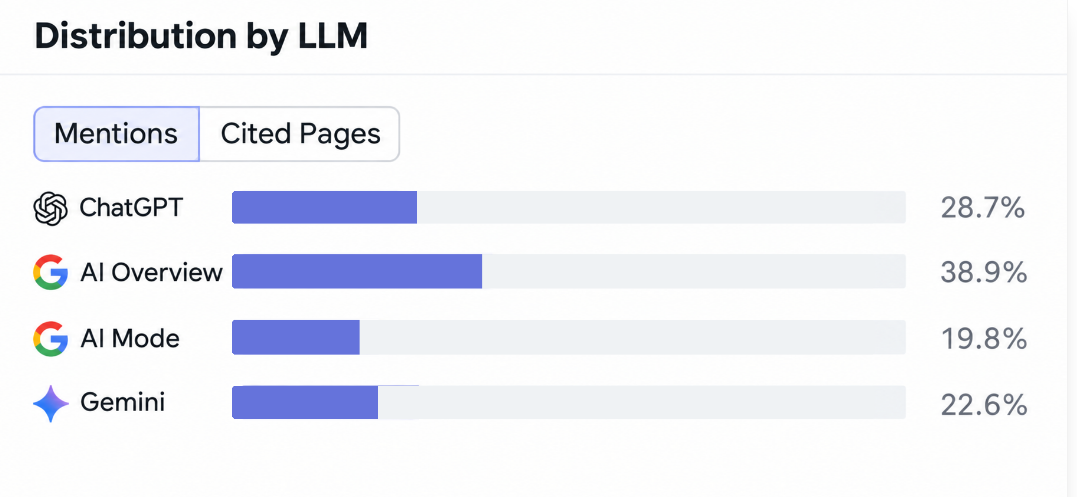
The more detailed reports allow you to explore where your brand's visibility comes from. For example, the 'Distribution by LLM' section shows which AI models mention your brand most frequently.
The 'Competitor Research' report helps you understand how your competitors are performing and how your brand compares. You can directly compare your AI visibility with that of other brands in your industry.
The 'Prompt Research' report is also useful, as it helps you discover what users are asking AI tools. You can then use these insights to refine your strategy for the weeks and months ahead.
Semrush AI Visibility Toolkit also helps you understand how your brand is represented in AI-generated responses. Its 'Brand Performance' reports cover:
- Share of Voice
- sentiment
- brand narratives
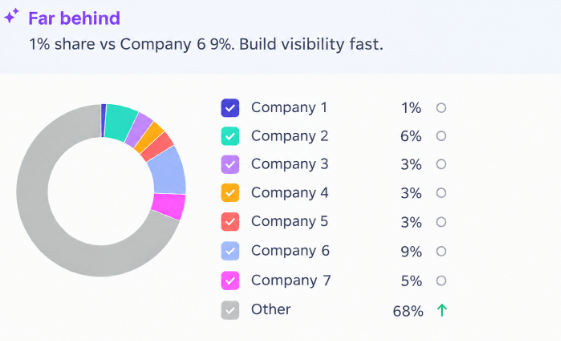
Other useful features include:
- 'Perception' report – tracks changes in sentiment over time, helping you understand how perceptions of your brand are evolving compared with competitors.
- 'Narrative Drivers' report – provides insights into factors shaping brand narratives, including the most frequently cited domains.
- 'Insights' and 'AI Strategic Opportunities' sections – summarise key findings to help you develop a more effective strategy.
- 'Site Audit' – identifies potential technical issues that could prevent your website from being included in AI-generated responses.
Become a source for AI
Publish sponsored articles and build links to strengthen your brand's online authority!
Ahrefs Brand Radar
This tool tracks metrics including:
- brand mentions
- citations
- Share of Voice
A mention is counted when a brand appears at least once in an AI-generated response. Even if the same company name appears three times in a single response, Ahrefs counts it as one mention.
You can track your own performance alongside that of your competitors, identify areas for improvement and find opportunities to get ahead.
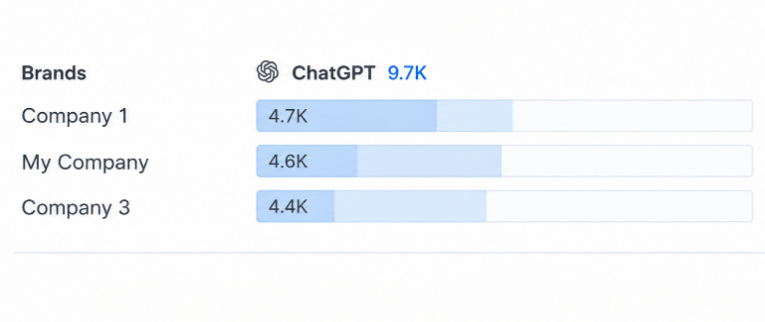
A citation is counted when a webpage appears at least once as a cited source in a generative AI response.
Ahrefs Brand Radar also tracks domain citations. How does this work? If at least one page from a particular domain is cited, the tool includes that domain in its results.
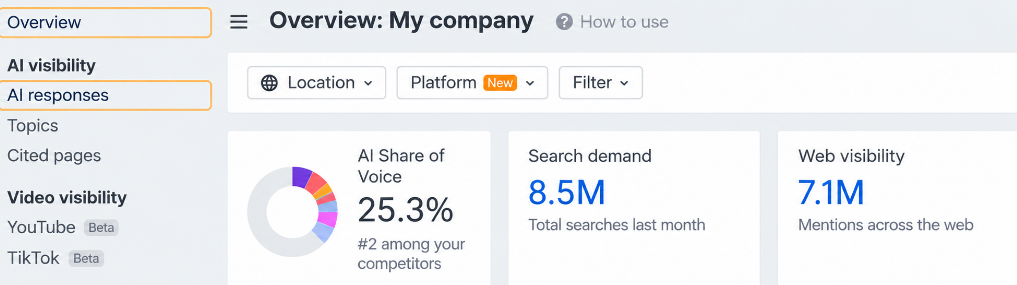
AI Share of Voice, meanwhile, represents a brand's percentage share of appearances compared with all other brands in the same category.
Other tools for monitoring AI visibility
- Profound AI – a marketing platform that provides brand performance reports, among other features. It analyses more than one billion citations every day.
- Peec AI – launched in Berlin in 2025, this tool allows you to analyse your brand's online visibility and rankings in AI search results.
- Otterly AI – lets you track brand mentions across ChatGPT, Perplexity and Google AI Overviews from a single dashboard.
- Scrunch AI – analyses brand presence in AI-generated responses, AI Share of Voice and emerging trends in AI-powered search.
- AthenaHQ – monitors brand mentions and rankings across more than eight AI systems. It also shows which external websites AI tools cite as sources.
- Promptwatch – helps you optimise brand visibility in ChatGPT and Gemini. You can also analyse real user prompts and the sources cited by AI.
Key takeaways
More people are turning to AI-powered tools every month. That means monitoring your brand's AI visibility is no longer something you can simply put off until later. Whether we like it or not, it's becoming essential.
The key is to regularly track metrics such as brand mentions, citations and conversions, using dedicated tools to understand how your brand is performing.
Some of the most popular options include Google Analytics 4, Google Search Console, Semrush AI Visibility Toolkit and Ahrefs Brand Radar. These tools can help you assess your brand's visibility in AI-generated responses, benchmark your performance against competitors and build a more effective strategy for the months ahead. The sooner you start tracking these metrics, the better placed you'll be to stay ahead of the competition.